
Every card says the same nothing
A name, a title, a company. None of it answers the only question the other person actually has, which is whether you can help them. Yours is the one that can answer it — and the one they show a colleague afterwards.
Tap, scan or send a link. Behind every card is a voice twin — trained on what you do — that answers the questions you would otherwise have to be there for.
Before email, a card got you past the switchboard. A name, a company, an extension that rang on somebody's actual desk — it was worth keeping because it did something. Then the internet arrived and the card became a formality: a rectangle you accept, pocket, and never look at again.
Most digital cards just re-stage that ritual on a phone. If all it does is hand over an address, you may as well have sent the email. What has actually been missing isn't the contact details. It's everything around them.
A name, a title, a company. None of it answers the only question the other person actually has, which is whether you can help them. Yours is the one that can answer it — and the one they show a colleague afterwards.

“Do you handle this sort of thing? Have you done it before? What does it cost?” The questions people never quite get round to sending. Asked at eleven at night, answered in your voice, from facts you approved.

One tap writes you into their contacts, with the twin still attached. A week later they search your name rather than their pockets — and can still ask it something.
There's no app to learn and nothing to configure. You have one conversation, we build the twin, and the card works everywhere a link works.
We interview you the way a good journalist would — what you do, what people always ask, what you're happy for it to say, and what's off-limits. That recording does double duty: it's your context, and it's the voice sample.
Five seconds of clean audio is enough to clone a voice. Ten minutes is enough to have something worth saying.
The interview becomes a context window: an approved set of facts the twin can use, and boundaries it won't cross. Your voice is cloned, or you pick a stock one if you'd rather the twin sounded like the brand than like you.
You approve every answer before anyone else hears one.
Let someone scan the QR, drop the link in an email signature, a WhatsApp bio or a link page. However it arrives, they land on your card, save your contact, and can ask the twin anything.
Same context window later powers your site, your app, your careers page.
Not mock-ups. Two working cards, built on the same system, each one wired to its owner's own context and voice. Open either and ask it something.
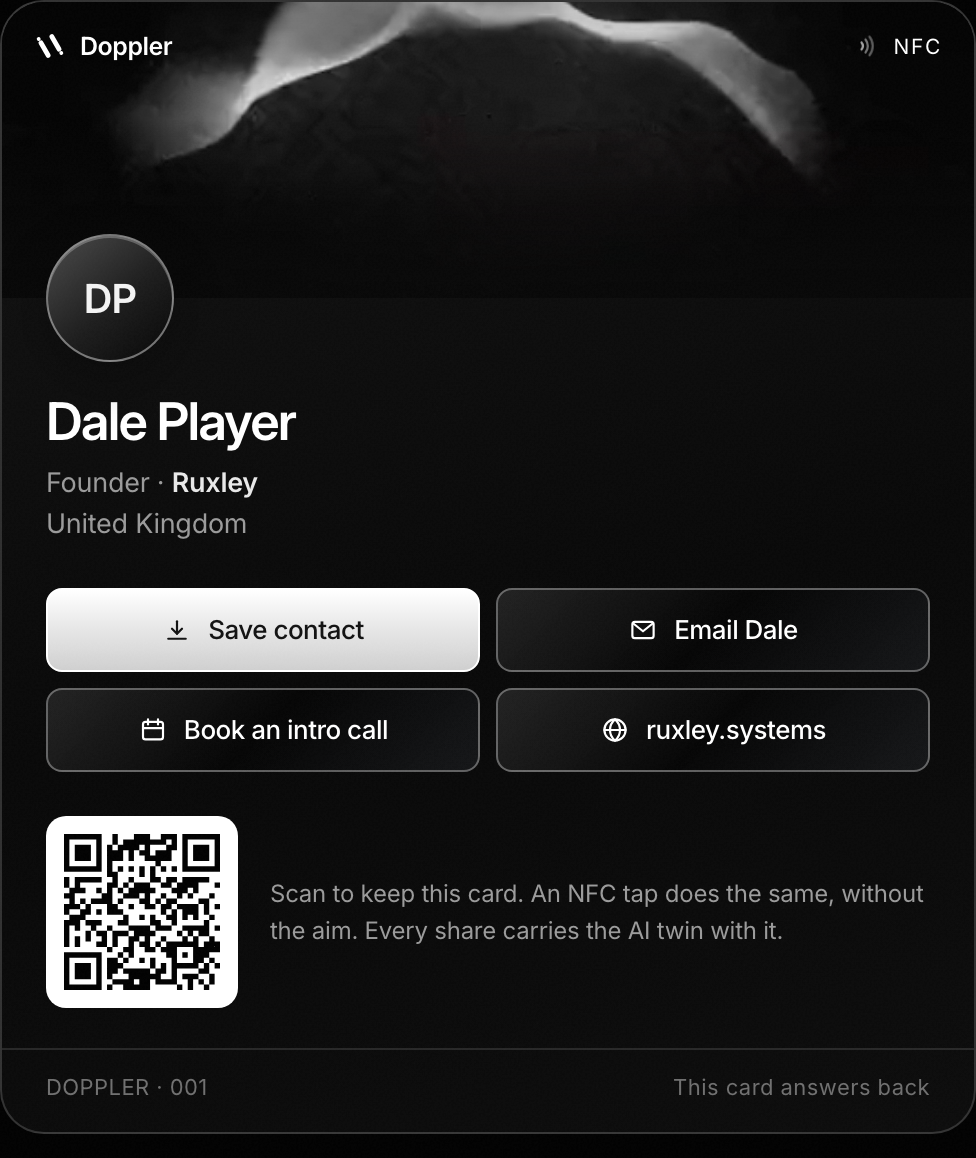
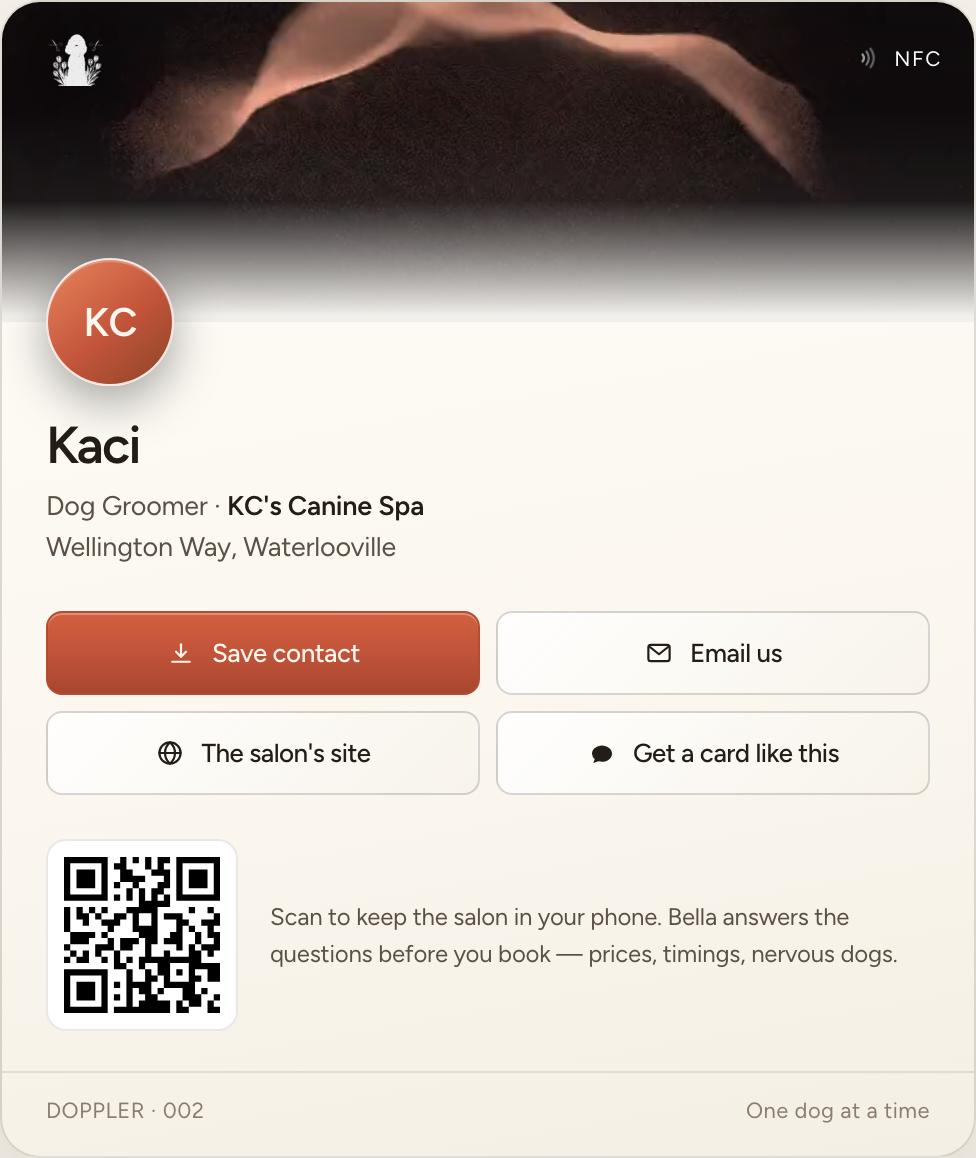
The next card is somebody's. Cards are numbered in the order they're built.
Claim the next numberYour card writes down every question anyone puts to it — including, especially, the ones it couldn't answer. Those come back to you as a short list. Answer one in your own words and it's recorded in your voice, permanently, in every phrasing someone might use to ask it.
Most cards are as good as they will ever be the day you're handed them. This one is at its worst on day one.
Every question, and whether it had a good answer. You get the thing no business card has ever given anyone: a record of what people actually wanted to know, in their words, at the moment they wanted to know it.
Ask it something twice and the second person gets the answer instantly.
Answer it however you'd say it in the van — a few rough words is plenty. We turn that into the answer you'd have given with time to think, using what you wrote and the context your card already holds. Never anything from thin air. Then you read the exact wording and change whatever you like before it's recorded.
Nothing goes on your card that you haven't read first.
You don't have to wait for strangers. The fastest way to make your twin good is to sit down and ask it the things your customers ask you — the awkward ones, the price one, the one you're bored of answering. Everything it fumbles lands on your list.
Half an hour of quizzing it is worth a month of waiting.
No setup fee, no contract, billed once a year. Both tiers get the same designed card and the same sharing — the difference is whether your twin sounds like a studio voice, or like you.
A studio voice answers on your behalf.
They hear you. Even when it isn't you.
Per card, per year, excluding VAT. Cancel any time — your card stays live as a plain contact page, and the context window and the writing are yours to take with you. Kitting out a team, or want us to run the whole thing for you? Get in touch and we'll sort it.
The twin can only work from a context window you approved — the facts about you and your business, written down and signed off. It's told, explicitly, to say it doesn't know rather than guess, and to send people to a real human when it's out of its depth.
We also write hard boundaries in: a groomer's twin won't give veterinary advice, and it won't invent a customer review. You see every stock answer before the card goes live.
Only if you want it. It takes a few seconds of clean audio, and the card says out loud that it's the AI version of you, not you. We only ever clone the voice of the person who sat in the interview and asked us to.
Plenty of businesses choose a stock voice instead — that's a brand assistant rather than a clone of the founder, which is often the better call for a team or a shop. KC's Canine Spa is built that way on purpose.
Then you still have the best-looking card in the room, and it still saves itself into people's phones. We'd rather say that plainly than pretend every contact becomes a conversation.
The twin earns its keep in the follow-up, not the handshake: the person who was interested, a day later, with a question they'd never bother emailing you about.
It's a link — which is why it works everywhere: a QR code, your email signature, a WhatsApp bio, a social profile, or printed on the back of an ordinary card. Nothing to post out, nothing to lose, and you can change what it says after you have handed it over.
Today it answers and hands off — it'll take someone to your email, your phone, your booking form. Live diary booking is what we're building next, and it's where the twin stops being a nice card and starts being an employee.
Doppler is built by Ruxley, a studio that modernises established businesses — sites, films, and AI agents that do real work. The card is usually the smallest, fastest thing we can build for someone. It's often not the last.
Tell us what you do and who you hand cards to. Build it yourself in about ten minutes — you answer a few questions out loud, and that same recording becomes both your voice and what your card knows.